
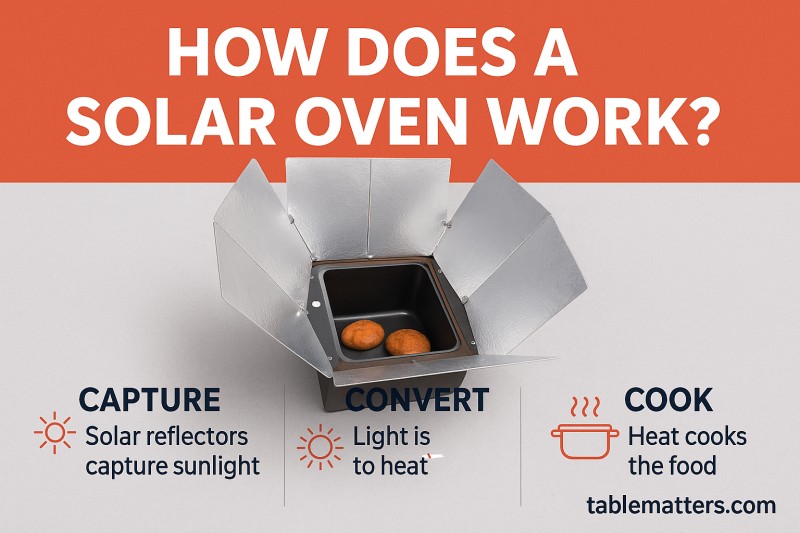
Every solar oven works basically by collecting, trapping, and accumulating heat from the sun.
How Do Solar Ovens Heat Up?
Collection
Solar ovens basically heat up by collecting the sun's energy and redirecting it towards pots.
To collect solar energy, manufacturers typically add reflectors to the design of their solar ovens. Such reflectors could be chromium, silver or aluminum foil. These reflectors focus the sunlight on the surfaces of pots, allowing them to warm up faster as they receive so much of the sun's rays within a short period. As the sun's rays get to the pot, it heats up and cooks the food within.
So, why do pots heat up when they receive sunlight? Well, every color of the visible light spectrum absorbs light waves to varying degrees. In general, darker colors absorb more light waves than brighter colors. This is why darker colors appear dull and dark and why brighter colors appear bright.
Similarly, the dark outer surface of a pot absorbs a high volume of light waves (including infrared waves) from the sun. As it does, it heats up and transfers the generated heat to the food within. Of course, as this happens, the food cooks.
Now, this does not mean you cannot use pans with brighter surfaces for solar cooking. Pans with brighter surfaces can still absorb heat by conduction. Since those with darker surfaces absorb heat through radiation and conduction, however, they cook faster.
Trapping and Accumulation
If solar cookers worked by only collecting infrared waves from the sun, most of the heat would be lost before enough is collected for cooking.
Various trapping mechanisms are put in place to ensure that the cooking pot gets enough warmth to cook food.
Such trapping and insulation methods include transparent glasses and transparent plastic bags. The glasses and plastic bags allow solar rays in. At the same time, they retain heat from the rays so it does not escape. And since the heat does not escape it accumulates, and ensures the food in the solar cooking oven is cooked.
Types of Solar Cookers (Solar Cooker Designs)
Box Solar Cookers
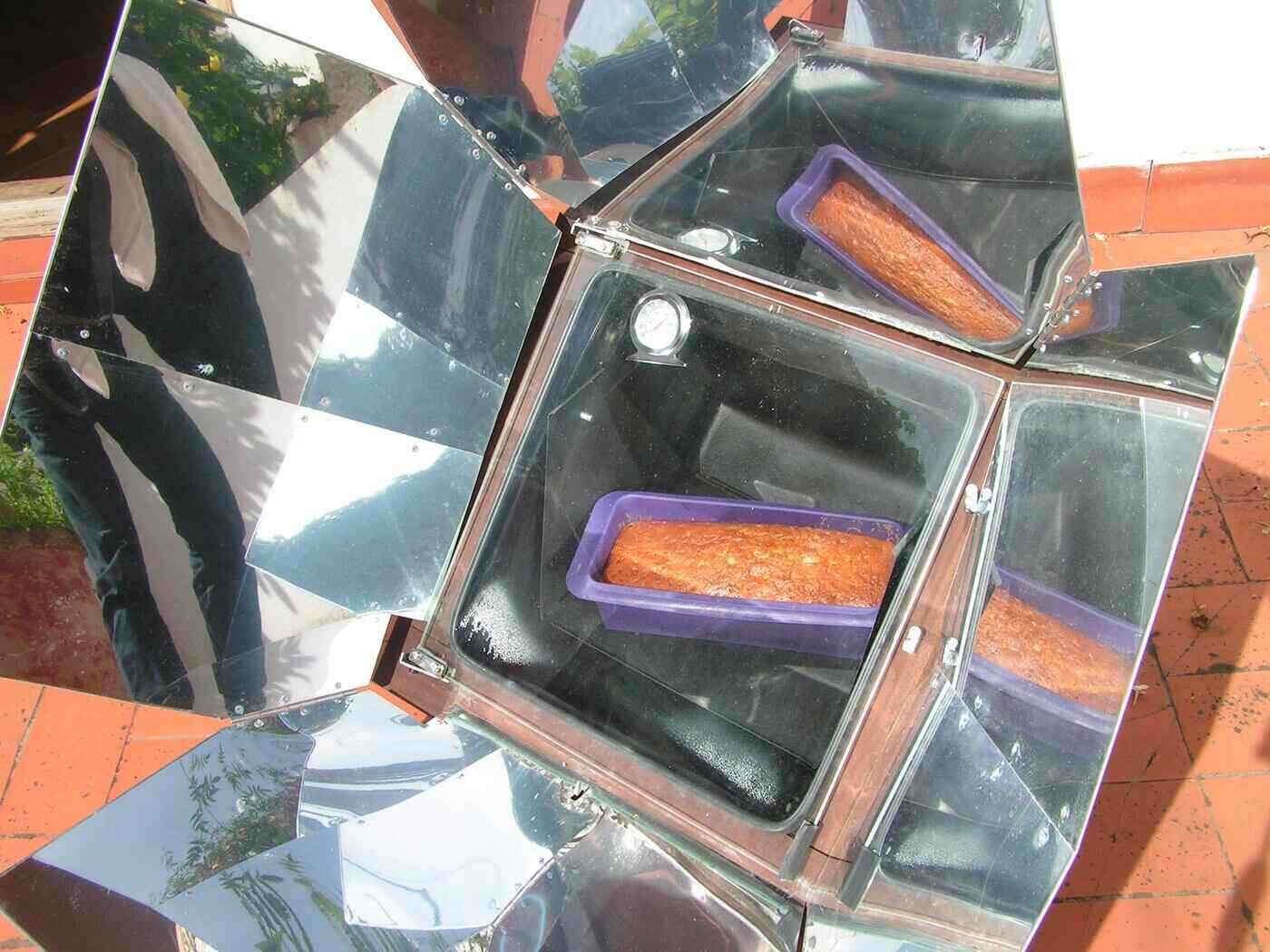
As the name says, these cookers are designed in the form of a box. They come with an interior lined with reflective material and a transparent cover.
A box cooker typically offers more space than other solar cooking oven designs. In fact, you might just be able to place more than one pot inside it at once.
When cooking with these types of cookers, avoid opening the cover. You should only open it when you have to release accumulated steam. Opening the cover will cause the cooker to lose the accumulated heat. This may further extend the cooking time.
Box cookers can reach temperatures as high as 300 under optimal conditions. One way to ensure they get as hot as possible is to keep the transparent lid clear at all times. Using pans with dark exteriors (especially ceramic pans) also improves cooking efficiency. You may even place a dark stone in the box to raise the overall heat collection.
Box solar cookers are typically used for foods like beans and other foods that have long cooking times. They may also be used in baking.
Parabolic Solar Cookers
A parabolic solar cooker shaped like a parabola. The interior of a parabolic cooker is lined with reflective materials, and the shape promotes heat concentration to a single point. This, in turn, allows them to reach high temperatures very quickly. You may have to change their position as the position of the sun changes, however.
Of all three designs, this design offers the highest possible temperatures. It can get as hot as 700. Hence, it is advised that you pay attention when using a solar parabolic cooker.
Panel Solar Cookers
Of all three designs, panel cookers are the lightest and least expensive, but then, the temperatures they reach are relatively lower than those of the other two designs. They typically only get as hot as 284.
Panel cookers have some of the features of the other two designs. They feature a large reflector area like the parabolic type. Like the box type, they come with an enclosure to keep cookware well-insulated. This enclosure could be a sealed transparent oven bag or any other transparent enclosure safe for use in ovens.
How Long Does It Take to Cook in a Solar Oven?
Well, various factors determine how long it takes to cook in a solar oven. Some factors include the design of the solar cooker, the materials of the cooking ware, the weather, the type of food and the ambient temperature.
As the factors above vary, the cooking time of solar ovens varies too. In many cases, your oven will only be suitable for slow cooking. Nonetheless, you can use the following times as a guide while you cook with your solar cooker:
- Melted cheese, butter, omelet and baked egg typically cook in less than an hour.
- Grains, vegetables and pastries (like cakes, cookies, bread, and brownies) should cook in 2 to 3 hours.
- Soup and whole vegetables should be ready in 3 to 4 hours.
- Dried beans, pumpkins, and large dishes typically cook in 4 to 7 hours.
Will a Solar Oven Function in the Winter?
A solar oven will work in winter if it gets enough sunlight. Still, it will not get to the same high temperatures as in spring or summer. This is because the ambient temperature is very low, and the intensity of sunlight in winter is less than in warmer seasons.
Conclusion
Unlike the usual slow cookers and ovens that run on gas or electricity, solar ovens work using solar energy. They channel solar radiation to the pot within them. The pot absorbs the radiation, gets hotter, heats up the food within it and ultimately cooks it.
The downside to solar ovens? The longer cooking times. The upside? Well, solar heat energy is free, renewable and does not hurt the environment.
View More in:
Why Trust Us?
Meet Our Kitchen Experts
At TableMatters.com, we’re committed to providing reliable, research-backed expert cooking tips and honest cookware reviews you can trust. Our content is created by trained chefs, experienced food writers and kitchen equipment experts who test recipes, compare tools and analyze ingredients with real-world accuracy.
Whether you’re searching for reliable vegetarian meal ideas, step-by-step cooking guides or detailed product comparisons, TableMatters.com provides expert-driven, easy-to-follow content designed to help every home cook cook smarter, eat healthier and enjoy better results.