

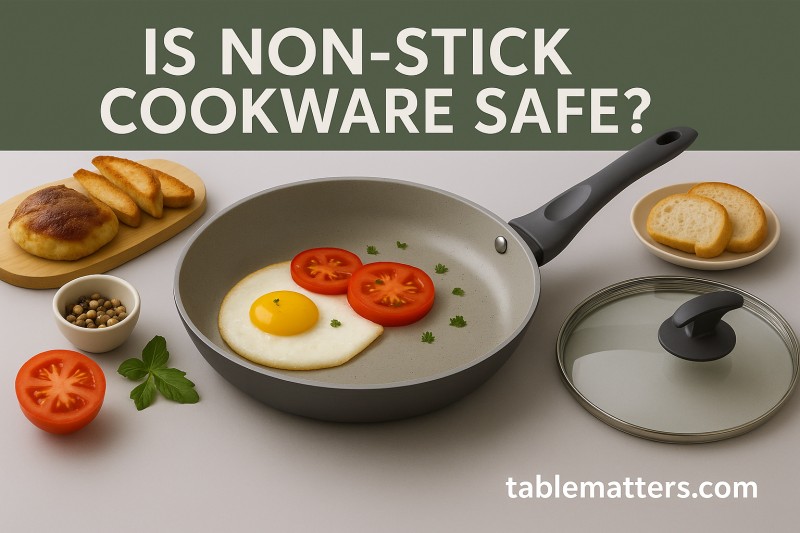
Non-stick cookware is incredibly popular in today's day and age. In fact, roughly 70 percent of cookware sold within the United States is non-stick. That popularity stems from the fact that such models are durable, sleek and easy to clean.
However, while all non-stick cookware is reliable, it's not always safe. There are a few different coatings used in today's market. Some of them come with little to no issues, but others can be hazardous to your health in certain situations. This article will analyze both sides of the spectrum to help you figure out which non-stick coatings are the best for your food.
Types of Non-Stick Coatings
When it comes to choosing non-stick cookware, there are quite a few choices. Teflon and ceramic, both covered in detail below, are the most popular, but there is also cast iron and porcelain enamel.
Cast iron pans, when properly seasoned, do a good job of repelling food. The cookware also has the benefit of being made with no toxic chemicals or harmful metal. That makes it an excellent choice for people who want something a bit more heavy-duty. However, they can leach iron into your meals. Though that isn't a large issue for many people, it can create problems for specific populations. Always be aware that using cast iron over long periods of time or with acidic foods can increase leakage.
Another popular non-stick option, porcelain enamel, does a great job at many different heats and is completely eco-friendly. While most porcelain enamel cookware sets have no health issues, low-quality ones can come with cadmium or lead. Older models used to use those in their glaze as well. If porcelain is the way you want to go with your non-stick cookware, always buy from a trusted and reputable source. Checking such pans in real life goes a long way towards that end.
Cast iron and porcelain enamel coatings are used in a wide variety of cookware. However, they are far from the most popular. Ceramic non-stick is a rising star in the cooking world, and Teflon still reigns supreme. However, many call the safety of both coatings into question. We'll address these concerns below.
Understanding Teflon
Teflon, also known as polytetrafluoroethylene (PTFE), first came about in the 1930s as a coating for wires and other similar materials. Twenty years later, manufacturers began to put it on pans. The substance has wonderful non-stick properties. It repels most food, requires no oil and is a synch to clean.
At the time of its creation, nobody thought anything about Teflon. It worked well, and because it worked well, it was put on all non-stick cookware. Unfortunately, as time went on and more studies occurred, that tune began to change.
Teflon: Potential Hazards

As effective as Teflon is, it does come with some potential health issues. In fact, Toxnet has it listed in its hazardous substances data bank. The reason for the classification is because, although the compound is stable in its regular state, it can release unhealthy chemicals when heated up to higher temperatures. Though you won't reach such heats from normal cooking, the chemicals can still leak out if the coating breaks down over time.
It's also worth noting that if the Teflon coating ever becomes scratched or melts, it can get into the food you're cooking. While the substance does not cause cancer, which is something many people incorrectly assume,ingesting the chemicals can lead to a condition known as Teflon flu. That comes with plenty of unfortunate symptoms, including fever, headaches, and chills.
Some studies have also found Teflon inhalation can lead to lung damage. However, that only occurs from long-term exposure at incredibly high temperatures (750 degrees Fahrenheit).
Most Teflon cookware you can find today is safe when used properly. The reason there is so much concern about the substance is the presence of a chemical known as perfluorooctanoic acid (PFOA), which can cause cancer over time. Teflon makers used PFOA until 2013, but they no longer employ the substance in their cooking. In that way, Teflon is a substance that, while not directly dangerous, can lead to certain health problems down the line.
What About Non-stick Ceramic Cookware - Is it Safe?
If you're concerned about Teflon (and you wouldn't be blamed if you were) but still want to use a non-stick coating, ceramic cookware is the way to go. There are currently two types of ceramic cookware: 100 percent ceramic and ceramic coated. Pure ceramic cookware contains no metal. It's crafted from a unique mixture of sand, minerals and clay that is fired at over 1900 degrees Fahrenheit to make them as durable as possible.
While you can find 100 percent ceramic pans, they are quite rare. Most of the time, when looking for a Teflon alternative, you want to turn to ceramic coated cookware.
To craft non-stick ceramic pots and pans, manufacturers use what is known as a use "Sol-Gel" process, where they convert the inorganic liquid into a strong gel that can be applied to any metal surface. Once applied, the cookware is then heated at extremely high temperatures. That makes the pans durable, creates strong food release and prevents a solid finish.
However, while the substance is similar to Teflon in terms on function (helping food effortlessly slide off your cooking equipment), it differs greatly in terms of safety classification.
Good for You and the Environment
When evaluating ceramic cookware vs. Teflon, it's important to note that ceramic is inorganic. That means it's environmentally friendly. The substance contains silicon and oxygen but does not necessarily have carbon.
In addition, ceramic cookware only requires one layer of application during the manufacturing process, unlike the three Teflon uses. It also needs less curing time and generates less than half the carbon dioxide emissions of Teflon. Not only that, but the pans do not leak harmful chemicals when heated at high temperatures. As such, the substance is considered safe "non-toxic" cookware.
Ceramic coating can withstand temperatures of up to 450 degrees Celsius, which is more than enough for any kitchen. While you should try to avoid using any non-stick surface on high heat for extended periods of time, as that can cause the coating to break down, a little extra time on the stove won't do any damage here.
Furthermore, non-stick ceramic coating contains no cadmium or lead. Though certain ceramic cookware may contain trace amounts of such metals when purchased from countries outside the U.S., strict regulations make it so that all American cookware products must have a label if they ever exceed 0.1 ppm for lead and 0.049 for cadmium. Always check for such labels when purchasing ceramic non-stick cookware. If you find one on a product that warns about the chemical composition, simply shop somewhere else. There are always safer options out there.
The Other Side of the Coin
Though ceramic coating is much safer than Teflon, it does come with its own risks. For instance, older ceramic cookware may contain lead. This is not a problem in modern pans because of new regulations, but older ceramic glazes used the dangerous metal as a stabilizing agent. That does not come out through cooking, but it can leak into food through the use of sharp utensils, acidic food or high heat.
Always go with a new purchase and try to avoid cooking with any old ceramic pans passed down through your family. They may be safe, but it's not worth the risk.
Another potential danger to consider when using ceramic cookware is aluminum. While not dangerous on its own, the metal can buckle when put under stress. If you put a hot pan into cold water it can flex, which then causes the non-stick coating to bubble up the next time you heat it on the stove. If that occurs, the coating can rub off and expose the aluminum coating underneath. This problem is quite rare, but it can cause the metal to enter your meal.
Finally, though ceramic cookware is distinctly different than Teflon, certain brands have some Teflon in them. Such substances may outgas when used on high heat over long periods of time. Just to be safe and buy brands that you know or trust to have safe chemicals. Toxic-free and environmentally friendly labels are both quite important when making your final purchasing decision.
Safe Non-Stick Cookware Overall
Teflon was once thought to be a safe, easy way to cook your food. You dropped in your meal, cooked it how it was supposed to be cooked and you were good to go. While it still functions in that way, new information on PTFE and PFOA shows that not everything is as great as it seems.
Ceramic cookware is much safer due to its natural heat resistance. It will not break down on the stove, nor will it release toxic chemicals if it's ever used at high temperatures. If you're looking for a ceramic frying pan in particular, check out our 8 Best Ceramic and Non-Stick Frying Pans Reviews & Buying Guide before making your choice.
View More in:
Why Trust Us?
Meet Our Kitchen Experts
At TableMatters.com, we’re committed to providing reliable, research-backed expert cooking tips and honest cookware reviews you can trust. Our content is created by trained chefs, experienced food writers and kitchen equipment experts who test recipes, compare tools and analyze ingredients with real-world accuracy.
Whether you’re searching for reliable vegetarian meal ideas, step-by-step cooking guides or detailed product comparisons, TableMatters.com provides expert-driven, easy-to-follow content designed to help every home cook cook smarter, eat healthier and enjoy better results.